


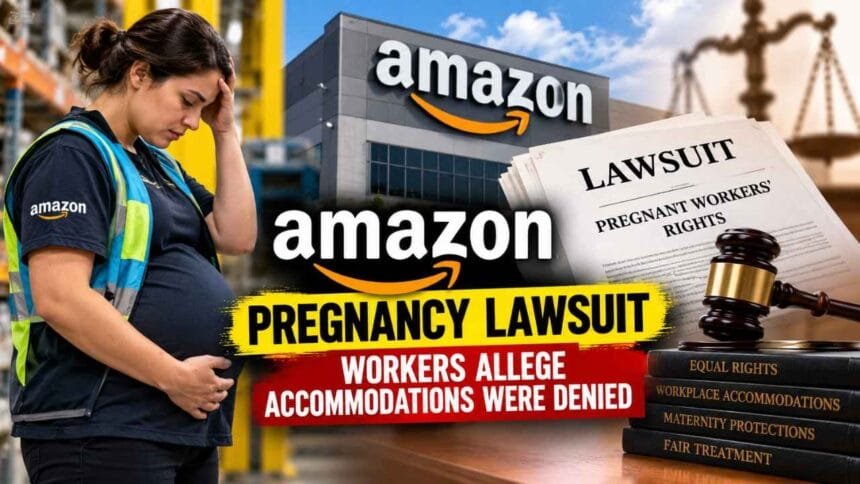
Amazon is facing a proposed nationwide class-action lawsuit accusing the company of failing to properly accommodate pregnant warehouse workers and allegedly punishing or terminating employees who needed pregnancy-related breaks, medical care or time away from work.
Four former Amazon warehouse employees filed the lawsuit in federal court in Brooklyn on September 8, alleging that the company’s workplace practices violated the federal Pregnant Workers Fairness Act (PWFA) and New York labor protections.
The complaint claims potentially thousands of current and former pregnant employees could have been affected.
What the Amazon Pregnancy Lawsuit Alleges
According to the complaint, pregnant workers were allegedly denied basic accommodations, including permission to sit, additional bathroom or water breaks, time for prenatal appointments and other adjustments related to pregnancy or childbirth.
The lawsuit further alleges that some workers were disciplined or fired after pregnancy-related absences depleted unpaid time-off balances or were recorded as excessive time away from work.
The plaintiffs also accuse Amazon of improperly demanding medical documentation for certain accommodation requests.
One plaintiff, Willamina Barclay, alleges she experienced a pregnancy-related medical emergency in June 2025 after suffering severe abdominal pain while lifting heavy objects at an Amazon warehouse in Rochester, New York.
The complaint says she was hospitalized and later received a termination warning before being fired several days afterward.
The other named plaintiffs are Jennifer Hatch, Kristina Green and Dazaria Parks.
Their allegations similarly involve requests for accommodations such as sitting, additional breaks, restroom access and pregnancy-related medical needs.
What the Pregnant Workers Fairness Act Requires
The PWFA took effect in 2023 and generally requires covered employers with at least 15 employees to provide reasonable accommodations for known limitations related to pregnancy, childbirth or related medical conditions, unless doing so would create an undue hardship.
The Equal Employment Opportunity Commission says possible accommodations can include additional restroom or water breaks, a stool or chair, schedule changes, temporary reassignment, lifting assistance and time off for medical appointments.
The law also prohibits adverse employment action because an employee requests or uses a reasonable accommodation.
Also Read: easyJet Faces $72 Million Lawsuit Over Six Abandoned Airbus Jets
Amazon’s Response to the Allegations
Amazon has rejected the lawsuit’s characterization of its practices. Spokesperson Kelly Nantel said the plaintiffs’ accounts contain inaccuracies and omit important details.
Amazon also said it provides pregnancy-related accommodations to tens of thousands of employees each year and approved more than 99.9% of pregnancy-related accommodation requests during the previous year.
The company said it does not tolerate discrimination or retaliation and takes an individualized approach to accommodation requests.
The new lawsuit follows earlier government scrutiny. In February 2026, the EEOC reportedly found reasonable cause to believe Amazon had violated the PWFA in connection with a complaint filed by Jennifer Hatch and indicated concerns involving a nationwide class of female warehouse associates.
The allegations in the new class-action lawsuit have not been proven in court, and Amazon has disputed the claims.
What Happens Next?
The lawsuit seeks compensation for affected workers as well as changes to Amazon’s policies and practices.
A major early question will be whether the court allows the proposed nationwide class action to proceed as a certified class.
The case could become an important test of how large employers apply pregnancy accommodation policies in physically demanding workplaces.
It also highlights a broader issue for workers: whether attendance systems and productivity rules properly account for legally protected pregnancy-related accommodations.
For pregnant employees, the EEOC recommends clearly informing an employer that a pregnancy-related limitation requires a workplace adjustment and engaging in the accommodation process.
The agency says workers generally do not need to use specific legal terminology to begin that process.
Key Facts
- Company: Amazon
- Case: Proposed nationwide class-action lawsuit
- Filed: September 8, 2026
- Court: U.S. District Court for the Eastern District of New York
- Named plaintiffs: Jennifer Hatch, Willamina Barclay, Kristina Green and Dazaria Parks
- Main allegations: Denied pregnancy accommodations, disciplinary action and alleged retaliatory terminations
- Federal law at issue: Pregnant Workers Fairness Act
- Amazon’s position: The company disputes the allegations and says more than 99.9% of pregnancy-related accommodation requests were approved during the previous year.
Frequently Asked Questions
Is Amazon being sued over pregnancy accommodations?
Yes. Four former warehouse employees have filed a proposed nationwide class-action lawsuit alleging Amazon failed to provide legally required pregnancy-related accommodations and punished workers who needed them.
What accommodations can pregnant workers request?
Under the PWFA, reasonable accommodations can include additional restroom or water breaks, permission to sit, schedule changes, temporary reassignment, lifting assistance and leave for pregnancy-related medical appointments, depending on the circumstances.
Did Amazon fire pregnant employees because they requested accommodations?
The lawsuit alleges that Amazon disciplined and terminated workers in connection with pregnancy-related accommodations and absences. Those allegations remain disputed and have not been established as facts by a court.
What has Amazon said about the lawsuit?
Amazon says the plaintiffs’ accounts contain inaccuracies and omit important details. The company also says it approved more than 99.9% of pregnancy-related accommodation requests in the previous year.
What is the Pregnant Workers Fairness Act?
The PWFA is a federal law requiring covered employers to provide reasonable accommodations for known limitations related to pregnancy, childbirth and related medical conditions, unless an accommodation would create an undue hardship.