

A fatal shooting involving a federal immigration officer has intensified tensions in Minneapolis, marking a controversial and deadly moment in the Trump administration’s latest immigration enforcement operation.
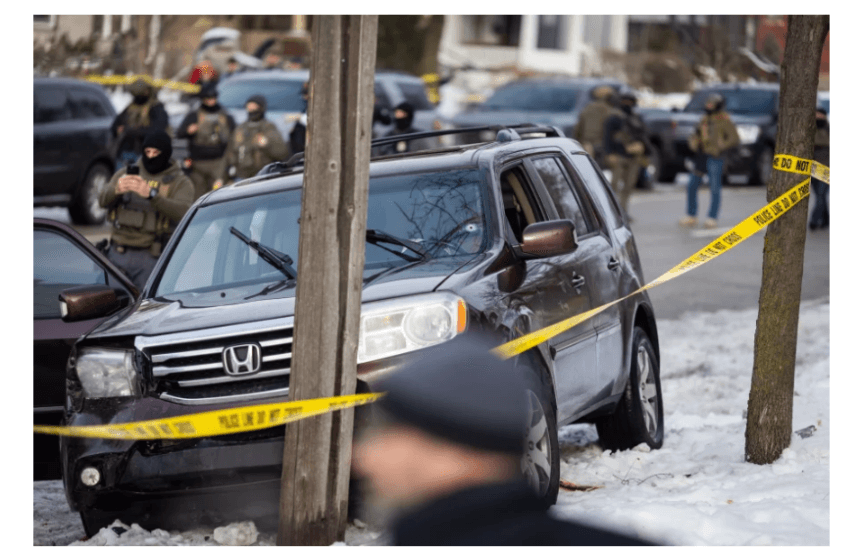
On Wednesday morning, an officer with U.S. Immigration and Customs Enforcement (ICE) shot and killed a 37-year-old woman while she was inside her vehicle in a residential neighborhood south of downtown Minneapolis.
Federal officials have characterized the shooting as self-defense, while city leaders and witnesses strongly dispute that account.
The incident occurred shortly after 9:30 a.m. near Portland Avenue, an area close to long-established immigrant communities and not far from the site where George Floyd was killed in 2020.
Videos recorded by bystanders show ICE officers confronting the driver of an SUV that was stopped in the roadway.
As the vehicle began to move forward, one officer positioned in front of it drew his weapon and fired at least two shots at close range.
The woman was struck in the head and later died, with a family member reportedly witnessing the shooting.
Homeland Security Secretary Kristi Noem said the officer acted to protect himself and others, alleging that the driver attempted to ram ICE personnel with her vehicle.
President Donald Trump echoed those claims on social media, defending the aggressive enforcement action.
However, Minneapolis Mayor Jacob Frey rejected that narrative after reviewing video footage, calling the shooting reckless, unnecessary, and preventable.
He sharply criticized the deployment of more than 2,000 federal immigration officers to the Twin Cities, saying it had created fear, chaos, and distrust rather than safety.
The shooting sparked immediate outrage. Hundreds of protesters gathered at the scene within hours, chanting slogans demanding ICE leave Minnesota.
By evening, a candlelight vigil drew a large crowd mourning the woman’s death and condemning federal immigration tactics.
Witnesses at the scene described the woman as trying to drive away, not attack officers, and questioned why lethal force was used.
Minnesota Governor Tim Walz acknowledged widespread anger and grief, calling the incident “predictable” and “avoidable.”
While saying he was prepared to deploy the National Guard if unrest escalated, Walz urged demonstrators to remain peaceful and not allow the situation to spiral into further violence.
Minneapolis Police Chief Brian O’Hara offered a brief account that notably avoided claims the driver posed an imminent threat, stating only that the vehicle began to drive off and shots were fired.
The FBI and state authorities are now investigating the shooting. The woman’s name has not yet been released, and officials caution that the inquiry is in its early stages.
Still, the killing has become a flashpoint in the broader debate over immigration enforcement, policing, and federal power, underscoring how quickly such operations can turn deadly and deepen divisions in already strained communities.