



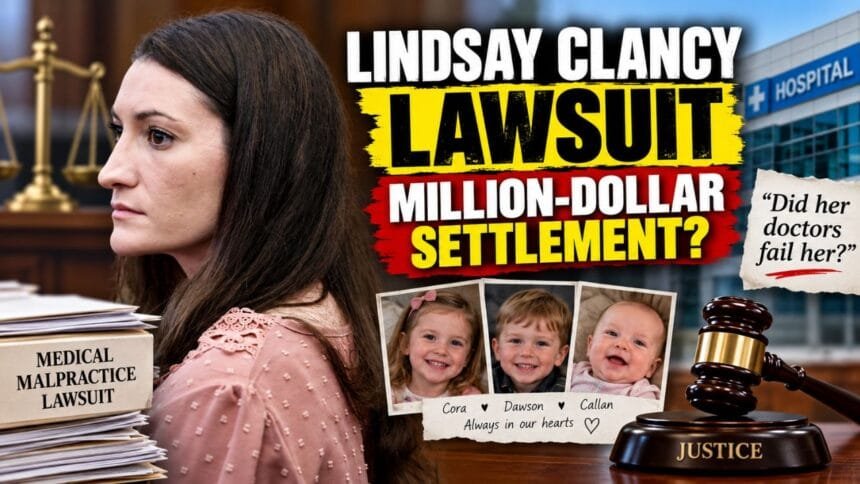
The 36-year-old Massachusetts mother’s criminal trial ended in a mistrial on September 4 after jurors failed to reach a unanimous verdict following more than 38 hours of deliberations.
Clancy has acknowledged killing her children but argued that she was not criminally responsible because she was experiencing severe postpartum psychosis.
At a glance
- Who: Lindsay Clancy, 36
- What: Criminal murder case and separate medical-malpractice litigation
- Where: Duxbury and Plymouth County, Massachusetts
- When: The children were killed on January 24, 2023; Clancy’s criminal trial ended in a mistrial in September 2026
- Why it matters: Jurors reportedly came close to finding Clancy not criminally responsible, potentially giving her attorneys a new argument in civil settlement negotiations.
Why did Lindsay Clancy’s criminal trial end in a mistrial?
The prosecution alleged that Clancy deliberately killed her children, Cora, 5, Dawson, 3, and Callan, 8 months old, with exercise bands before attempting suicide.
Her defense did not dispute that she caused the children’s deaths. Instead, attorney Kevin Reddington argued that a severe psychotic episode left Clancy unable to understand the wrongfulness of her actions.
After seven days of deliberations, the jury remained deadlocked.
Three jurors subsequently described a dramatic 11-to-1 split, saying 11 members were prepared to find Clancy not guilty by reason of lack of criminal responsibility while one juror refused to agree.
The judge ultimately declared a mistrial.
The mistrial does not mean Clancy was acquitted. The criminal case remains unresolved, and prosecutors could seek another trial. A September 29 hearing is scheduled to address the next steps.
How could the hung jury affect Clancy’s lawsuit against doctors?
Clancy has a separate civil lawsuit against healthcare providers who treated her during the months preceding the killings.
According to reporting on the lawsuit, her legal team alleges that providers failed to properly identify her deteriorating psychiatric condition, including alleged bipolar disorder and severe postpartum mental illness.
The lawsuit also challenges aspects of the medications and treatment she received while her symptoms were worsening.
That civil case is legally separate from the murder prosecution. Nevertheless, the criminal trial exposed extensive evidence about Clancy’s psychiatric history, treatment and behavior before January 2023.
New York attorney Seth Zuckerman told the New York Post that the jury’s apparent view of the evidence could potentially become a bargaining tool during mediation or settlement discussions.
The argument would essentially be that jurors who spent weeks hearing medical and psychiatric testimony found substantial doubt about Clancy’s criminal responsibility.
Also See: Amazon Plane Crash in Miami: Wrongful Death Lawsuit Filed After 5 Airport Workers Killed
Could the Lindsay Clancy settlement reach millions?
That remains speculative.
A seven-figure settlement is possible in theory, but there is no reported agreement establishing that Clancy will receive millions of dollars.
Any settlement would depend on negotiations, insurance coverage, the strength of the medical-malpractice evidence and whether Clancy can prove that healthcare providers breached the applicable standard of care and that their conduct legally caused compensable harm.
A difficult criminal prosecution can sometimes influence civil negotiations because defendants and insurers weigh the cost, uncertainty and publicity associated with taking a case to trial. But a mistrial alone does not establish medical negligence.
The healthcare providers could argue that Clancy’s criminal outcome says little about whether their treatment met the required medical standard.
A civil court would have to examine the medical records, expert testimony, treatment decisions and causation independently.
What exactly does Clancy allege against her medical providers?
The lawsuit focuses on the months when Clancy’s mental health reportedly deteriorated after the birth of her youngest child.
Published accounts describe escalating anxiety, insomnia, depression, suicidal thoughts and intrusive thoughts involving her children.
Her treatment reportedly involved several medications and multiple healthcare providers, with her defense arguing that her condition ultimately progressed into postpartum psychosis.
Clancy’s civil attorneys allege that the providers failed to recognize or adequately respond to the seriousness of her condition.
Those allegations have not been conclusively established in court.
Her former husband, Patrick Clancy, also has separate civil litigation involving healthcare providers connected to her treatment.
Timeline of the Lindsay Clancy case
May 2022: Clancy’s third child, Callan, was born.
Late 2022: Her mental-health problems reportedly intensified, including insomnia, anxiety, depression and disturbing thoughts.
January 24, 2023: Clancy killed her three children at the family’s Duxbury home and then attempted suicide.
2023–2026: The criminal case and related civil litigation continued while questions about Clancy’s mental state and medical treatment remained central.
September 4, 2026: A judge declared a mistrial after the criminal jury could not reach a unanimous verdict.
September 2026: Several jurors publicly discussed the deliberations and said most members supported a finding that Clancy was not criminally responsible.
September 29, 2026: A court hearing is scheduled to address what happens next in the criminal case.
What happens next?
The biggest immediate uncertainty is whether prosecutors will retry Clancy.
Following the mistrial, Plymouth County District Attorney Timothy Cruz said no final decision had been made. A second trial could also affect the timing and strategy of the related civil lawsuits.
There is another important complication: if the criminal case continues, Clancy’s lawyers may have to consider how participation in the civil litigation could affect her constitutional rights in the criminal proceedings.
For the medical-malpractice lawsuits, the central question will ultimately be different from the question presented to the murder jury: Did the healthcare providers fail to meet the applicable standard of care, and did that failure legally cause the injuries and damages alleged?
What we know, and what remains alleged
Established: Clancy’s criminal trial ended in a mistrial after a deadlocked jury.
Reported by jurors: Eleven jurors were prepared to find her not criminally responsible, according to several jurors who spoke publicly after the trial.
Alleged: Clancy’s civil lawsuit claims medical providers failed to properly diagnose and treat her deteriorating mental health.
Not established: The mistrial did not determine that her doctors or hospitals were legally responsible for the killings.
Unresolved: Whether prosecutors will pursue another criminal trial and whether Clancy’s civil claims will result in a settlement or trial.
Frequently asked questions
Is Lindsay Clancy guilty or not guilty?
The criminal case has not produced a final verdict. The judge declared a mistrial after jurors could not unanimously decide the case.
Does the hung jury mean Clancy will receive a settlement?
No. The criminal and civil cases are separate. The jury’s deliberations could provide negotiating leverage, but they do not prove medical malpractice.
Is Lindsay Clancy suing her doctors?
Yes. Clancy has filed civil litigation involving healthcare providers who treated her before the January 2023 killings. Patrick Clancy has also filed separate litigation involving providers.
Could the settlement be worth millions?
It is possible but unconfirmed. Legal experts have suggested that the civil case could potentially have significant settlement value, but there is no reported million-dollar settlement agreement at this time.
What happens to Lindsay Clancy now?
She remains in custody at a state psychiatric facility while the criminal case remains unresolved. Prosecutors could pursue a retrial, while the defense is seeking dismissal following the mistrial.
Bottom line
The Lindsay Clancy lawsuit now enters a potentially consequential phase.
Her defense can point to the extraordinary 11-to-1 jury split as evidence that the psychiatric and medical evidence raised substantial questions about her responsibility.
But that argument is not the same as proving that her doctors committed malpractice.
Whether the development ultimately produces a seven-figure settlement will depend on evidence that has yet to be tested in the civil proceedings, including medical records, expert opinions, causation and the providers’ defenses.
For now, the most significant development is that Clancy’s criminal case remains unresolved while her separate fight with the healthcare providers continues.