


Truck accidents are among the most devastating crashes on American roads. While car accident claims can be challenging, truck accident cases often involve a much higher level of complexity due to federal regulations, multiple liable parties, extensive evidence, and significantly larger financial stakes.
Commercial trucking is heavily regulated in the United States, and determining liability often requires a detailed investigation that goes far beyond a typical auto accident claim.
The trucking industry is regulated by the Federal Motor Carrier Safety Administration, which enforces safety standards for commercial vehicles and drivers.
Here are 10 key reasons truck accident claims are more complicated than standard car accident cases.
1. Multiple Parties May Be Liable
In a typical car accident, liability usually falls on one or more drivers.
In a truck accident, responsibility may extend to the truck driver, trucking company, cargo loaders, maintenance contractors, vehicle manufacturers, or even third-party logistics providers.
Determining who contributed to the crash requires a thorough investigation.
2. Federal and State Regulations Apply
Commercial trucking companies must comply with numerous federal and state regulations.
These rules govern driver qualifications, vehicle maintenance, cargo securement, and hours of service.
Violations of these regulations can play a significant role in establishing negligence.
3. Trucking Companies Have Rapid Response Teams
Many trucking companies deploy accident response teams immediately after a serious crash.
These teams often include investigators, insurance representatives, and attorneys whose goal is to protect the company’s interests.
Critical evidence can be collected quickly, making it essential to preserve evidence as soon as possible.
4. More Evidence Must Be Examined
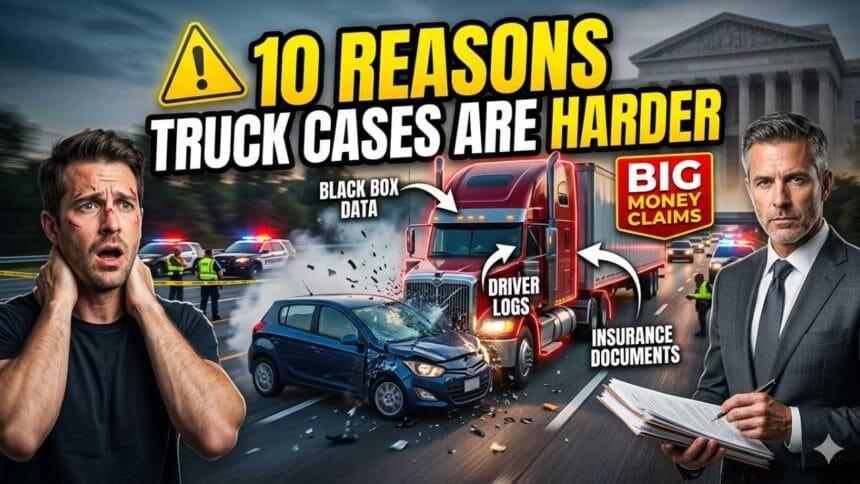
Truck accident investigations frequently involve electronic logging devices (ELDs), black box data, driver logs, maintenance records, GPS tracking information, inspection reports, and cargo manifests.
Reviewing and analyzing this evidence requires specialized knowledge and resources.
5. Severe Injuries Lead to Higher Damages
Because commercial trucks can weigh up to 80,000 pounds when fully loaded, collisions often result in catastrophic injuries or fatalities.
Victims may face lifelong medical treatment, rehabilitation, disability, and loss of earning capacity. The greater the damages, the more aggressively insurers often defend claims.
6. Complex Insurance Coverage Issues
Trucking companies typically carry much larger insurance policies than ordinary drivers.
In addition, multiple insurance policies may apply, including coverage for the driver, trucking company, trailer owner, cargo company, and other parties.
Sorting through these policies can be a complicated process.
7. Driver Fatigue Is Often a Factor
Federal Hours-of-Service regulations limit how long truck drivers can operate without rest.
Investigators frequently examine driver logs and electronic records to determine whether fatigue contributed to the accident.
Violations of these rules can significantly impact liability.
8. Vehicle Maintenance Records Matter
Commercial trucks require regular inspections and maintenance. Brake failures, tire blowouts, steering defects, and other mechanical issues can contribute to crashes.
Investigating maintenance histories often reveals whether a trucking company failed to keep its fleet in safe operating condition.
9. Accident Reconstruction Is Often Necessary
Truck crashes frequently require expert accident reconstruction.
Specialists may analyze skid marks, vehicle damage, road conditions, electronic data, and witness statements to determine exactly how the collision occurred.
This level of analysis is less common in ordinary car accident cases.
10. Litigation Is Often More Aggressive
Because truck accident claims often involve substantial financial exposure, defendants are more likely to contest liability and damages.
Trucking companies and insurers frequently retain experienced defense attorneys and expert witnesses to challenge claims.
This can result in longer negotiations and more complex litigation.
Final Thoughts
Although both car and truck accidents can lead to serious injuries, truck accident claims involve unique legal, regulatory, and evidentiary challenges.
Multiple potentially liable parties, extensive federal regulations, large insurance policies, and catastrophic damages make these cases significantly more complex than standard automobile accident claims.
Successfully pursuing compensation often requires a detailed investigation, preservation of critical evidence, and a thorough understanding of trucking industry regulations.
For accident victims, understanding these complexities is the first step toward protecting their rights and seeking fair compensation after a serious commercial truck collision.